Issued: London, UK
For media and investors only
GSK data at ASH show potential to redefine outcomes for people living with blood cancers
- Long-term data from DREAMM-7 and DREAMM-8 highlight sustained benefits of belantamab mafodotin in treatment of relapsed or refractory multiple myeloma
- DREAMM-9 evaluates an optimal dosing schedule for belantamab mafodotin in newly diagnosed multiple myeloma
- Updated analyses from MOMENTUM, SIMPLIFY-1, and preliminary data from ODYSSEY reinforce momelotinib’s potential in achieving spleen and anaemia benefits associated with survival outcomes in myelofibrosis
GSK plc (LSE/NYSE: GSK) will present new data from its haematology portfolio at the 67th American Society of Hematology (ASH) Annual Meeting and Exposition (6 - 9 December), reinforcing its potential to redefine outcomes for patients with difficult-to-treat blood cancers.
New results from the DREAMM programme for belantamab mafodotin further support its potential to extend remission in relapsed or refractory multiple myeloma, with development in newly diagnosed patients underway
Key presentations include:
- Updated results from DREAMM-8 (median 35.8 months of follow-up) explore depth of response and sustained benefit for patients with relapsed or refractory multiple myeloma (Abstract #2264)
- DREAMM-7 post hoc analysis explores patient characteristics and outcomes associated with duration and depth of response in responders with progression-free survival (PFS) greater than three years (Abstract #2262)
- Combined DREAMM-7 and DREAMM-8 subgroup analysis evaluates PFS and minimal residual disease negativity rates following treatment with belantamab mafodotin versus standard of care therapies in patients with functional high-risk relapsed or refractory multiple myeloma, a population with typically poor outcomes (Abstract #5820)
- Analyses from DREAMM-9 in transplant-ineligible newly diagnosed multiple myeloma patients assess the potential for higher initial dose intensity to optimise response, followed by dosing schedule extensions to minimise the potential for eye-related side effects (Abstract #5840)
New analyses for momelotinib build on positive MOMENTUM and SIMPLIFY trial results, assessing spleen and anaemia endpoints alongside overall survival, and early results from a first combination trial will be presented
Additional analyses from MOMENTUM and SIMPLIFY-1 highlight the ability of momelotinib to improve haemoglobin levels and achieve a dual response — both transfusion independence and spleen volume reduction — and the association of these outcomes with survival outcomes in myelofibrosis patients with or without prior JAK inhibitor therapy. (Abstract #2023)
Preliminary efficacy and safety results will be shared from the ODYSSEY trial — the first combination trial for momelotinib evaluating it in combination with luspatercept. The trial explores whether momelotinib’s unique dual mechanism, targeting both anaemia and splenomegaly, can serve as a foundational backbone in future combination therapies to deliver deeper, more durable responses. (Abstract #3803).
Additional presentations include:
- Post hoc analysis from the MOMENTUM trial assesses the association between increased momelotinib exposure and greater anaemia-related benefits in patients previously treated with JAK inhibitors (Abstract #5580)
- Analyses show momelotinib survival results in intermediate- and high-risk patients as defined by the RR6 model following switch from ruxolitinib, a standard of care, at or before 6 months (Abstract #5579)
Full list of GSK’s presentations at ASH:
Belantamab mafodotin
| Abstract name | Presenter | Presentation details |
|---|---|---|
| Deep responses and durable outcomes in patients treated with belantamab mafodotin plus pomalidomide and dexamethasone from long-term follow-up of the phase 3 DREAMM-8 study | S. Trudel | Poster, Abstract #2264 |
| Long-term responders from the phase 3 DREAMM-7 study of belantamab mafodotin plus bortezomib and dexamethasone vs daratumumab plus bortezomib and dexamethasone in relapsed/refractory multiple myeloma | V. Hungria | Poster, Abstract #2262 |
| Functional high-risk relapsed/refractory multiple myeloma (RRMM) outcomes with belantamab mafodotin (belamaf): DREAMM-7 and DREAMM-8 subgroup analysis | M. Mateos | Poster, Abstract #5820 |
| Health-related quality of life with belantamab mafodotin in patients with relapsed or refractory multiple myeloma (RRMM): An exploratory analysis of overall quality of life in DREAMM-7 | S. Lonial | Poster, Abstract #4029 |
| Belantamab mafodotin (Belamaf) in combination with bortezomib, lenalidomide, and dexamethasone (VRd) for patients (pts) with transplant-ineligible (TI) newly diagnosed multiple myeloma (NDMM): A focus on treatment efficacy and management/resolution of ocular events in the Phase 1 DREAMM-9 study | S. Usmani | Poster, Abstract #5840 |
| Patients with relapsed/refractory multiple myeloma who achieved sustained minimal residual disease negativity in the DREAMM-7 trial | M. Mateos | Poster, Abstract #2265 |
| Impact of belantamab mafodotin–containing regimens on renal function in patients with relapsed/refractory multiple myeloma (RRMM) and mild/moderate renal impairment in the DREAMM-7 and DREAMM-8 trials | M. Lacerda | Poster, Abstract #2260 |
| Belantamab mafodotin (belamaf) ocular events are manageable and reversible with dose modifications guided by standard assessments | S. Lonial | Poster, Abstract #4055 |
| An exploratory analysis of health-related quality of life measures with belantamab mafodotin in combination with pomalidomide and dexamethasone (BPd) in patients with relapsed or refractory multiple myeloma (RRMM) enrolled in DREAMM-8 | P. Richardson | Poster, Abstract #2284 |
| Patient-reported outcomes from DREAMM-7 and DREAMM-8 using the EQ-5D-3L, patient global impression of severity, and patient global impression of change | S. Trudel | Poster, Abstract #5823 |
| Integrated modeling analyses for belantamab mafodotin in combination with standard of care in patients with relapsed/refractory multiple myeloma (RRMM) From DREAMM-6, DREAMM-7, and DREAMM-8 | F. Carreño | Poster, Abstract #4043 |
| Years of life lost to multiple myeloma remains high: A targeted literature review | A. Bates | Poster, Abstract #2804 |
| Life-years and quality-adjusted life-years with belantamab mafodotin, bortezomib, and dexamethasone vs alternative regimens in patients with relapsed/refractory multiple myeloma who received ≥1 prior line of therapy | A. Suvannasankha | Poster, Abstract #4041 |
| Chimeric antigen receptor T cells in real-world care of multiple myeloma: Patient characteristics and healthcare resource utilization | N. Boytsov | Poster, Abstract #2787 |
| Bispecific antibodies in real-world care of multiple myeloma: Patient characteristics and healthcare resource utilization | N. Boytsov | Poster, Abstract #2790 |
| Characteristics of patients with relapsed/refractory multiple myeloma (RRMM) in Europe and the US | L. Kalilani | ePublication |
| Indirect treatment comparison of belantamab mafodotin + pomalidomide + dexamethasone Versus comparator regimens in lenalidomide-exposed relapsed/refractory multiple myeloma: A network meta-analysis | J. Richter | ePublication |
| Administration- and adverse event-related costs among patients with multiple myeloma treated with B-cell maturation antigen (BCMA)-targeted agents | N. Boytsov | ePublication |
Momelotinib
| Abstract name | Presenter | Presentation details |
|---|---|---|
| Dual transfusion independence and spleen volume reduction is associated with overall survival in patients with myelofibrosis treated with momelotinib: Post hoc analyses of SIMPLIFY-1 and MOMENTUM | B. Psaila | Poster, Abstract #2023 |
| Association between momelotinib exposure and hemoglobin improvement in patients with myelofibrosis and anemia: An exposure-response and time-to-event analysis | V. Gupta | Poster, Abstract #5580 |
| Preliminary experience from the ODYSSEY trial: Efficacy and safety of momelotinib in combination with luspatercept in patients with transfusion-dependent myelofibrosis | P. Bose | Poster, Abstract #3803 |
| Survival outcomes in ruxolitinib-treated patients with myelofibrosis following crossover to momelotinib: Application of the response to ruxolitinib at 6 months (RR6) prognostic model to SIMPLIFY-1 | R. Rampal | Poster, Abstract #5579 |
| Impact of hemoglobin improvement with momelotinib on survival in patients with myelofibrosis and anemia: Post hoc analyses of the SIMPLIFY-1 and MOMENTUM trials | P. Vachhani | Poster, Abstract #5581 |
| Transfusion independence with momelotinib regardless of baseline erythropoietin levels in the Phase 3 SIMPLIFY-1 trial | S. Oh | Poster, Abstract #2025 |
| Survival and clinical outcomes in patients with myelofibrosis and new or worsening anemia treated with ruxolitinib: A systematic review and meta-analysis | A. Kuykendall | Poster, Abstract #2031 |
| Impact of new or worsening anemia and thrombocytopenia on clinical outcomes in JAK inhibitor–naive myelofibrosis patients treated with ruxolitinib | V. Gupta | Poster, Abstract #3809 |
| Unveiling prognostic subtypes in myelofibrosis through routine blood counts: a population-based analysis of the cytopenic and proliferative phenotypes in andalusia, spain | R. Garcia Delgardo | ePublication |
| Discovery of drug combinations with momelotinib to improve myelofibrosis outcomes | S. O'Brien | ePublication |
| Momelotinib’s unique polypharmacology supports indication expansion beyond myelofibrosis | S. O'Brien | ePublication |
Full list of Alliance, investigator-initiated studies and supported collaborative studies:
| Abstract name | Presenter | Presentation details |
|---|---|---|
| Belantamab mafodotin | ||
| Target antigen density impacts clinical response in multiple myeloma patients undergoing treatment with elotuzumab and belantamab mafodotin | N. Neparidze | ePublication |
| Can a patient questionnaire (VRAT) reduce the need for ocular examinations with less frequent belantamab mafodotin combined with bortezomib and dexamethasone? The UKMRA PROMMISE D trial | R. Popat | Poster, Abstract #4065 |
| Belantamab mafodotin, nirogacestat, and pomalidomide in patients with relapsed/refractory multiple myeloma | M. Hultcrantz | Poster, Abstract #4060 |
| Hematologist-led ocular safety management using the vra tool with belantamab mafodotin plus lenalidomide/dexamethasone in transplant ineligible NDMM: updated results from the RP2D cohort | E. Terpos | Poster, Abstract #4038 |
| Phase II trial of belantamab mafodotin, carfilzomib, pomalidomide, and dexamethasone in multiple myeloma following BCMA CAR T-cell therapy | B. Derman | Poster, Abstract #5832 |
| Momelotinib | ||
| Preliminary data from the Phase I/II study of nuvisertib, an oral investigational selective PIM1 inhibitor, in combination with momelotinib showed clinical responses in patients with relapsed/refractory myelofibrosis | J. Mascarenhas | Oral, Abstract #482 |
About multiple myeloma
Multiple myeloma is the third most common blood cancer globally and is generally considered treatable but not curable.1,2 There are approximately 180,000 new cases of multiple myeloma diagnosed globally each year.3 Research into new therapies is needed as multiple myeloma commonly becomes refractory to available treatments.4 Many patients with multiple myeloma, including approximately 70% in the US, are treated in a community cancer setting, leaving an urgent need for new, effective therapies with manageable side effects that can be administered outside of an academic centre.5,6,7
About myelofibrosis
Myelofibrosis is a rare blood cancer that disrupts the body’s normal production of blood cells because of dysregulated JAK-signal transducer and activator of transcription protein signalling. The clinical hallmarks of myelofibrosis are splenomegaly (enlarged spleen), severely low blood counts, including anaemia and thrombocytopenia, and debilitating constitutional symptoms, such as fatigue, night sweats and bone pain, attributable to ineffective haematopoiesis and excessive production of proinflammatory cytokines.8,9
About belantamab mafodotin
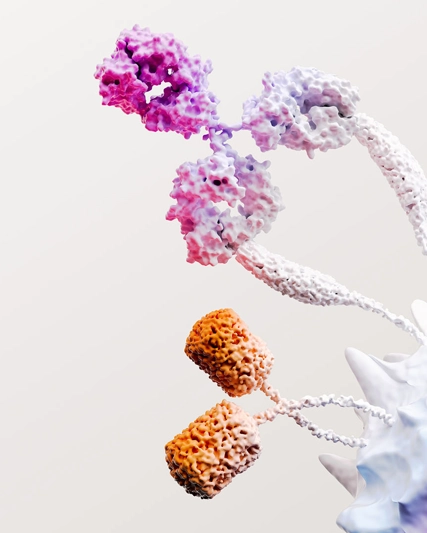
Belantamab mafodotin is a monoclonal ADC (antibody-drug conjugate) comprising a humanised BCMA (B-cell maturation antigen) conjugated to the cytotoxic agent monomethyl auristatin F via a non-cleavable linker. The drug linker technology is licensed from Seagen Inc.; the monoclonal antibody is produced using POTELLIGENT Technology licensed from BioWa Inc., a member of the Kyowa Kirin Group.
In October 2025, the US FDA approved10 belantamab mafodotin under the brand name Blenrep in combination with bortezomib and dexamethasone (BVd) for the treatment of adult patients with relapsed or refractory multiple myeloma who have received at least two prior lines of therapy, including a proteasome inhibitor and an immunomodulatory agent.
Belantamab mafodotin in combination with bortezomib and dexamethasone and belantamab mafodotin in combination with pomalidomide and dexamethasone are approved in 2L+ relapsed or refractory multiple myeloma in the European Union11, UK12, Japan13, Canada, Switzerland and Brazil.
Applications are currently under review in other markets globally, including China14 where the application is based on the results of DREAMM-7 and has been granted Breakthrough Therapy Designation and Priority Review.
Indication
In the US, Blenrep is indicated in combination with bortezomib and dexamethasone (BVd) for the treatment of adult patients with relapsed or refractory multiple myeloma who have received at least two prior lines of therapy, including a proteasome inhibitor and an immunomodulatory agent.
Please see accompanying US Prescribing Information.
About momelotinib
Momelotinib has a differentiated mechanism of action, with inhibitory ability along three key signalling pathways: Janus kinase (JAK) 1, JAK2, and activin A receptor, type I (ACVR1).15,16,17,18 Inhibition of JAK1 and JAK2 may improve constitutional symptoms and splenomegaly.15,16,17 Additionally, inhibition of ACVR1 leads to a decrease in circulating hepcidin levels, potentially contributing to anaemia-related benefit.15,16,17,18
In September 2023, the US Food and Drug Administration approved19 momelotinib under the brand name Ojjaara for the treatment of intermediate or high-risk myelofibrosis, including primary myelofibrosis or secondary myelofibrosis (post-polycythaemia vera and post-essential thrombocythemia), in adults with anaemia.
In January 2024, the European Commission granted marketing authorisation20 for momelotinib for disease-related splenomegaly (enlarged spleen) or symptoms in adult patients with moderate to severe anaemia who have primary myelofibrosis, post polycythaemia vera myelofibrosis or post essential thrombocythemia myelofibrosis and who are Janus kinase (JAK) inhibitor naïve or have been treated with ruxolitinib. Momelotinib was also approved21 by the Medicines and Healthcare products Regulatory Agency (MHRA) in the United Kingdom to treat the symptoms experienced by adult myelofibrosis patients who have moderate or severe anaemia.
In June 2024, the Japan Ministry of Health, Labour and Welfare (MHLW) approved22 momelotinib for the treatment of myelofibrosis. Momelotinib is currently approved in 21 countries and applications are under review in other markets globally.
Important information for momelotinib in the EU
Indication
Momelotinib is indicated for the treatment of disease-related splenomegaly (enlarged spleen) or symptoms in adult patients with moderate to severe anaemia who have primary myelofibrosis, post polycythaemia vera myelofibrosis or post essential thrombocythaemia myelofibrosis and who are Janus kinase (JAK) inhibitor naïve or have been treated with ruxolitinib.
Refer to the Omjjara EMA Reference Information for a full list of adverse events and the complete important safety information in the EU.
GSK in oncology
Our ambition in oncology is to help increase overall quality of life, maximise survival and change the course of disease, expanding from our current focus on blood and women’s cancers into lung and gastrointestinal cancers, as well as other solid tumours. This includes accelerating priority programmes such as antibody-drug conjugates targeting B7-H3 and B7-H4, and IDRX-42, a highly selective KIT tyrosine kinase inhibitor.
About GSK
GSK is a global biopharma company with a purpose to unite science, technology, and talent to get ahead of disease together. Find out more at www.gsk.com.
Cautionary statement regarding forward-looking statements
GSK cautions investors that any forward-looking statements or projections made by GSK, including those made in this announcement, are subject to risks and uncertainties that may cause actual results to differ materially from those projected. Such factors include, but are not limited to, those described in the “Risk Factors” section in GSK’s Annual Report on Form 20-F for 2024, and GSK’s Q3 Results for 2025.
References
- Sung H, Ferlay J, Siegel R, et al. Global Cancer Statistics 2020: GLOBOCAN Estimates of Incidence and Mortality Worldwide for 36 Cancers in 185 Countries. CA Cancer J Clin. 2021;71(3):209-249. doi:10.3322/caac.21660.
- Kazandjian D. Multiple myeloma epidemiology and survival: A unique malignancy. Semin Oncol. 2016;43(6):676–681.doi: 10.1053/j.seminoncol.2016.11.004.
- Global Cancer Observatory. International Agency for Research on Cancer. World Health Organization. Multiple Myeloma fact sheet. Available at: https://gco.iarc.who.int/media/globocan/factsheets/cancers/35-multiple-myeloma-fact-sheet.pdf. Accessed 6 November 2025.
- Nooka AK, Kastritis E, Dimopoulos MA. Treatment options for relapsed and refractory multiple myeloma. Blood. 2015;125(20). doi:10.1182/blood-2014-11-568923.
- Komodo claims data. Accessed 25 September 2025.
- Gajra A, Zalenski A, Sannareddy A, et al. Barriers to Chimeric Antigen Receptor T-Cell (CAR-T) Therapies in Clinical Practice. Pharmaceut Med. 2022 Jun;36(3):163-171.
- Crombie J, Graff T, Falchi L, et al. Consensus recommendations on the management of toxicity associated with CD3×CD20 bispecific antibody therapy. Blood (2024) 143 (16): 1565–1575.
- Atallah E, Verstovsek S. Emerging drugs for myelofibrosis. Expert Opin Emerg Drugs. 2012 Dec;17(4):555-70. doi: 10.1517/14728214.2012.748748. PMID: 23186315; PMCID: PMC5009610.
- MPN Research Foundation. Primary Myelofibrosis (PMF). 2021. Accessed August 2022. http://www.mpnresearchfoundation.org/primary-myelofibrosis-pmf/
- GSK press release issued 23 October 2025. Blenrep approved by US FDA for use in treatment of relapsed/refractory multiple myeloma. Available at: https://www.gsk.com/en-gb/media/press-releases/blenrep-approved-by-us-fda-for-use-in-treatment-of-relapsedrefractory-multiple-myeloma/.
- GSK press release issued 24 July 2025. Blenrep (belantamab mafodotin) combinations approved in EU for treatment of relapsed/refractory multiple myeloma. Available at: https://www.gsk.com/en-gb/media/press-releases/blenrep-belantamab-mafodotin-combinations-approved-in-eu-for-treatment-of-relapsedrefractory-multiple-myeloma/.
- GSK press release issued 17 April 2025. Blenrep (belantamab mafodotin) combinations approved by UK MHRA in relapsed/refractory multiple myeloma. Available at: https://www.gsk.com/en-gb/media/press-releases/blenrep-belantamab-mafodotin-combinations-approved-by-uk-mhra-in-relapsedrefractory-multiple-myeloma/.
- GSK press release issued 19 May 2025. Blenrep (belantamab mafodotin) combinations approved in Japan for treatment of relapsed/refractory multiple myeloma. Available at https://www.gsk.com/en-gb/media/press-releases/blenrep-belantamab-mafodotin-combinations-approved-in-japan/.
- GSK press release issued 9 December 2024. Blenrep (belantamab mafodotin) combination accepted for priority review in China in relapsed/refractory multiple myeloma. Available at: https://www.gsk.com/en-gb/media/press-releases/blenrep-belantamab-mafodotin-combination-accepted-for-priority-review-in-china-in-relapsedrefractory-multiple-myeloma/.
- Chifotides, HT, Bose, P, Verstovsek, S. Momelotinib: an emerging treatment for myelofibrosis patients with anemia. J Hematol Oncol. 2022;15(7):1-18.
- Verstovsek S, et al. MOMENTUM: momelotinib vs danazol in patients with myelofibrosis previously treated with JAKi who are symptomatic and anemic. Future Oncol. 2021;17(12):1449-1458.
- Asshoff M, et al. Momelotinib inhibits ACVR1/ALK2, decreases hepcidin production, and ameliorates anemia of chronic disease in rodents. Blood. 2017;129(13):1823-1830.
- Oh S, et al. ACVR1/JAK1/JAK2 inhibitor momelotinib reverses transfusion dependency and suppresses hepcidin in myelofibrosis phase 2 trial. Blood Adv. 2020;4(18):4282-4291.
- GSK press release issued 15 September 2023: Ojjaara (momelotinib) approved in the US as the first and only treatment indicated for myelofibrosis patients with anaemia. Available at https://www.gsk.com/en-gb/media/press-releases/ojjaara-momelotinib-approved-in-the-us-as-the-first-and-only-treatment-indicated-for-myelofibrosis-patients-with-anaemia/
- GSK press release issued 29 January 2024: European Commission authorises GSK’s Omjjara (momelotinib). Available at https://www.gsk.com/en-gb/media/press-releases/european-commission-authorises-gsk-s-omjjara-momelotinib/
- MHRA press release issued 31 January 2024: Omjjara licensed for anaemic myelofibrosis patients to treat the symptoms of their disease. Available at https://www.gov.uk/government/news/omjjara-licensed-for-anaemic-myelofibrosis-patients-to-treat-the-symptoms-of-their-disease
- GSK press release issued 24 June 2024: GSK’s Omjjara (momelotinib) approved in Japan for treatment of myelofibrosis. Available at https://www.gsk.com/en-gb/media/press-releases/gsk-s-omjjara-momelotinib-approved-in-japan-for-treatment-of-myelofibrosis/