Hepatitis B is a viral liver infection affecting hundreds of millions of people worldwide, but poor awareness means just a fraction know they are affected. Left untreated, chronic hepatitis B infection increases the risk of developing liver cancer or cirrhosis. Researchers at GSK are identifying ways to manage chronic hepatitis B with the aim to improve patients’ quality of life. Mother of two Natalia shares her journey from diagnosis to treatment, and the constant worries she has as she raises a family.
Thirty-nine-year-old Natalia is used to packing bags for her family to visit southwestern Poland, where she grew up. They return multiple times a year from their current home in Germany to be closer to family and enjoy the peace and quiet of the countryside. As she packed up their things to return this summer, the mother of two knew the essentials: passport, money, phones.
But top of the list was her medication.
“I check my bags twice, three times and ask okay, is the medication there? Can I go?,” Natalia tells GSK. “I pack multiple packs across different bags. It’s a worry whenever I leave for a couple of days, or for a holiday.”
Eight years ago, just as she started her family, Natalia was diagnosed with hepatitis B, a liver infection caused by the hepatitis B virus (HBV), which attacks and inflames the liver, putting people at the risk of developing severe liver damage or liver cancer.
Natalia’s infection is chronic, and her medication lifelong. She must remember to take it daily without fail. “My pills are labelled by day to make sure I’ve taken them and I set multiple alarms to make sure I do,” she explains.
Even on treatment, the worry sits dormant in her mind.
“It comes back in very happy moments. So, when I'm exceptionally happy, when something amazing has happened, I just think, oh my God, but I have this condition,” she says. “It brings me down to earth... These moments of happiness get marred by hepatitis B.”

Tackling motherhood and a life-changing diagnosis
Natalia learned of her infection while carrying her first child in 2018. She went for routine tests over Christmas which brought the unfathomable revelation.
“I was already heavily pregnant, and I didn't fully understand what hepatitis B meant,” Natalia says. “And pregnancy is a very vulnerable phase of a woman’s life.”
The highly contagious virus affects around 240 million people chronically, but few know they live with it, according to the World Health Organization (WHO). For women, diagnosis often occurs during pregnancy as they are screened for preexisting conditions including HIV/AIDS and hepatitis B.
As clinics closed for the holiday period, the recruiter says she received a government letter informing her that her blood tests were positive for HBV.
“At first, I really thought that that's a mistake. It can't be me,” Natalia said. “I have never had any symptoms or anything that would lead me to think that I had this condition.”

Hepatitis B transmits through infected blood or bodily fluids and infections can be hard to identify based on symptoms alone. Almost a million people were newly infected in 2024.
Natalia’s virus levels were not a concern during her first pregnancy, she says. Her doctor referred her to see a specialist several months down the line and she then went for regular check-ups to monitor the infection.
Unlike viral diseases with distinct signs like chickenpox or measles, hepatitis B manifests differently. For some, like Natalia, there could be no signs for years as the virus quietly multiplies within the liver, while in others, symptoms may appear two or three months after infection, such as extreme fatigue, yellowing of the skin due to jaundice, or pain in the upper back.
Infections can either be acute (short-term) or chronic (long-term) depending on how successfully the immune system responds. Once an infection exceeds six months, it’s considered chronic.
“Chronic hepatitis B is a dynamic disease. The disease progresses through phases of being active or inactive, bouncing back and forth in some cases, which can last anywhere from a few years to decades,” said Attila Mihalyi, GSK’s global medical lead for hepatitis B. “The disease progression is not linear.”
Vaccinations are available and are typically given to children in three doses in many parts of the world, with some countries recommending them at infancy. Adults are also eligible for the vaccinations.
Hepatitis B in numbers (2024)
Global Burden
240mNew Infections
0.9mMortality
1.1m
“Many people think that chronic hepatitis B is no longer an issue because we have vaccinations,” said Mihalyi. “While vaccination programs are highly efficient, they may not reach everybody on time and millions of people were infected before they became available in the 1980s. Additionally, for the people who are already affected by chronic hepatitis B, vaccination will not help.”
Chronic viral hepatitis B continues to be one of the leading infectious disease killers worldwide and hundreds of millions live with the disease globally, particularly in parts of Asia and Africa. Around 1.7 million are living with the condition in the US, contributing to thousands of cases of liver cancer.
Mihalyi adds that lack of awareness further fuels the burden. “Due to the low focus on [hepatitis B] in many parts of the world, people are actually not getting tested.”
WHO estimates that only 27% of those living with chronic hepatitis B are aware of their condition, of whom less than 5% are on treatment, and the agency’s latest global report shows deaths have risen since 2015 due to limited diagnosis and treatment.
“Improved screening is absolutely important because that's the only way to know if somebody has chronic hepatitis B or not,” Mihalyi adds.
Mother to child transmission is the most common path for the hepatitis B infection to spread. Without vaccination soon after birth, infants who contract HBV from their mothers face a 90% risk of developing a chronic infection. When Natalia’s daughter was born, she promptly vaccinated her to bolster protection against the virus.
“I was reassured by my doctor that my baby would be vaccinated at birth and that she would be fine,” Natalia says.

Treatment for life
Natalia’s second pregnancy in 2021 was a turning point. A few weeks after birth, her tests showed a sharp increase in her viral load — the level of HBV in her blood — which prompted doctors to put her on treatment. The medication is lifelong.
“This was the moment when I realised, okay, this is serious. This isn't what I thought it was,” she says.
In retrospect, Natalia describes her life in two parts: before and after her medication began. One part was light and carefree, the other is now scary, full of worry and means a different quality of life.
“A lot of my thoughts circle around the fact that I've got the condition. How long have I got? Can I look after my children until they’re grown up, and they can live their own life, and they do not need me to fall back on?” said Natalia.
Her daughters have been vaccinated and her medication is keeping her infection under control for now, she says, but she must stay on it and continues to have regular check-ups.
“That was reassuring, but still very scary,” Natalia says, but adds that she also worries about having access to her medication. “What happens if the medication is not available or accessible for whatever reason?”

How does hepatitis B affect the liver and body?
Hepatitis B is one of five virus strains for hepatitis, ranging from A to E, that inflame the liver, but hepatitis B has the greatest burden of infections and mortality, causing an estimated 1.1 million HBV-related deaths in 2024, according to the WHO.
Once the virus enters the blood stream, it targets the liver and symptoms, if any, may appear between 40 and 160 days from the time of infection.
Hepatitis B has been called a “silent killer” by the WHO for the insidious way in which it attacks the liver while avoiding the immune system, making it challenging to kill the virus entirely. This means patients currently on daily medication need lifelong treatment.
How HBV infects and damages the body:
- A protein on the surface of the virus, the Hepatitis B surface antigen (HBsAg), targets and attaches to receptors on the surface of liver cells.
- Once attached, the virus enters the liver cells, releases its DNA and forms a unique structure called covalently closed circular DNA (cccDNA) inside the nucleus of these cells. The cccDNA remains permanently in the liver cells, enabling the virus to replicate.
- The immune system attacks and kills infected liver cells and in doing so, repeatedly inflames the liver, causing damage over time.
- The cycle of damage to the liver can scar the liver tissue — causing fibrosis. Continued injury to the liver then paves the way for more severe damage, like cirrhosis, which then increased the risk of liver cancer.
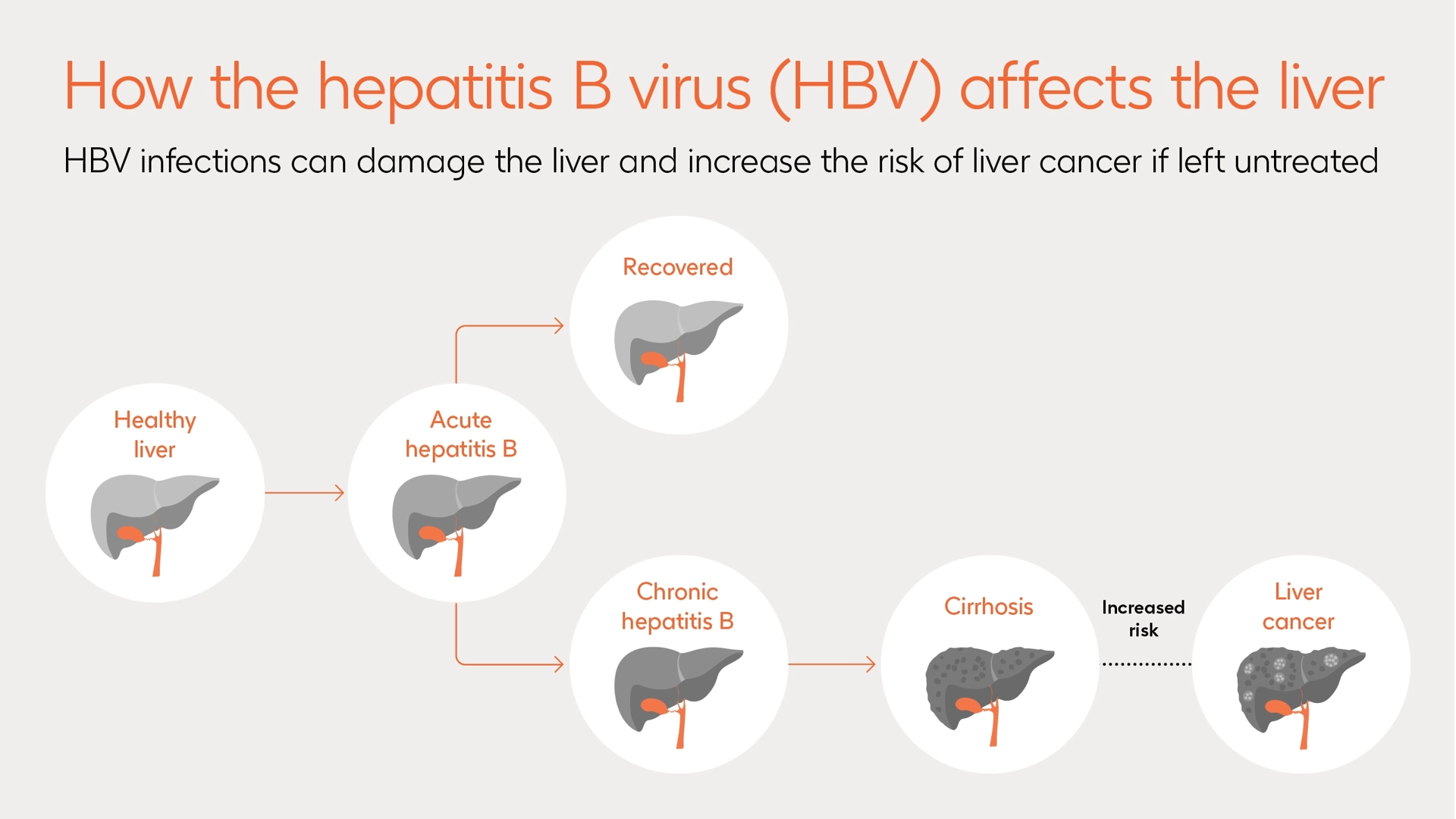
In an acute case of hepatitis B, the immune system may attack and clear the virus naturally, which is often the case if infected as an adult. Infections go from acute to chronic when the virus persists for more than six months. Infants and children have immature immune systems that HBV can evade, posing a higher risk of infections becoming chronic, explains Mihalyi.
“Most chronic hepatitis B cases stem from newborn or childhood infections, but they only get diagnosed several years or sometimes decades later because in the beginning they will not have symptoms,” Mihalyi said.
Treatments for chronic hepatitis B suppress the virus and, when taken consistently over time, help reduce the risk of liver disease and liver cancer — but that risk is not eliminated. To improve outcomes, scientists are researching ways to better manage the condition with the aim of improving quality of life and further reducing the risk of liver damage.
“In the world right now, a little over a million people die every year from HBV-related diseases. That's one every two minutes,” explains Melanie Paff, vice president and medicines development leader for Hepatitis B at GSK. “At the end of the day, you want people to be able to live their normal lives and not have this fear holding over them.”
Adapting to life and stigma with chronic hepatitis B
“There's a lot of stigma around being chronically infected with anything,” explains GSK’s Paff. “People don't want to touch you, they don't want to be around you. Therefore, very few people proactively go out and ask to be tested.”
Natalia shares that the mental toll of her diagnosis was significant. When she was first put on medication, while managing a young family, she constantly sought information on how her disease was progressing and whether her daughters would be completely safe as they grew older.
“I was beating myself up about it because in my mind, I was a reckless mum. It led me to be more conscious and scared about the way I handled my daughters’ injuries or when they wanted to eat something that I ate or drink from my cup.”
It was the small, day-to-day things that Natalia needed answers for. For example, whether it was safe for her children to eat from her plate or touch her things.
Casual contact such as sharing cutlery or hugging don’t spread HBV, according to the Centers for Disease Control and Prevention. Sharing personal items like razors and toothbrushes can, however, increase the risk of passing on the virus.
Natalia eventually found what she needed to know by speaking to others with chronic hepatitis B, and her experience motivated her to speak openly about the disease and encourage other women to adapt to living with the virus.
“They were grateful to be reassured. It's not ideal, but you can live with chronic hepatitis B and you can find your way to be hopeful and happy,” said Natalia.
Natalia shares that, over time, she learned to relax more in their home, no longer separating her things in the kitchen, for example. But she still keeps her toothbrush apart, and her towels, and says she worries whenever her daughters get a cut or a wound, or when she gets one herself.
“I know I’m being paranoid, but I’m scared. And worried,” she says.
She adds that she is also always thinking about the health of her liver. “I don’t drink alcohol anymore, not even a little, and I avoid eating too much sugar,” she shares. “I don’t want to put any stress on my liver.”
For her part, Natalia tries to stay hopeful about a future she hopes will be filled with adventures as her daughters begin school.
“I'm just looking forward to accompanying them on that journey to grow, to be more independent, and to experience life together with them,” said Natalia. “But I miss being care-free, like I was before. The worry never goes away.”
Hepatitis B: At a Glance
People with knowledge of their hepatitis B diagnosis
27%People on treatment for hepatitis B
<5%Risk of developing chronic hepatitis B among infants infected at birth
90%